
AI Receptionist for Plumbing Companies: A Practical Buyer’s Guide
September 07, 2026
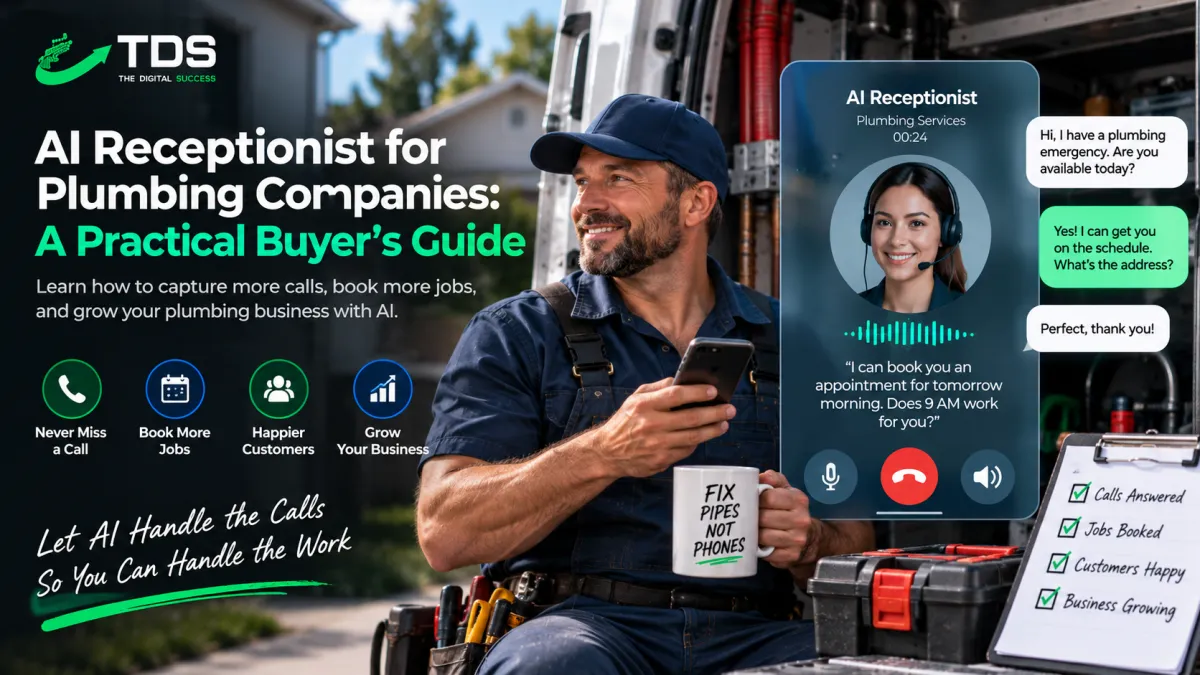
Every unanswered plumbing call can turn into a job for another contractor. Homeowners dealing with an overflowing toilet, leaking water heater, or backed-up drain rarely want to leave a voicemail and wait. They usually call the next company that answers.
An AI receptionist for plumbers gives plumbing companies a practical way to answer calls around the clock, collect job details, schedule eligible appointments, and route urgent situations to the right person. Unlike a basic voicemail system, it can hold a natural conversation and follow workflows built around your service area, availability, and dispatch policies.
What Is an AI Receptionist for Plumbers?
A plumbing AI receptionist is a voice-based software agent that answers inbound calls using conversational artificial intelligence. It can ask questions, interpret a caller’s responses, complete approved tasks, and record the conversation outcome in connected business systems.
For example, a caller may say, “My water heater is leaking all over the garage.” The receptionist can confirm the address, ask whether the water or gas supply has been shut off, identify whether the property is within your service area, and transfer the call to an on-call technician when required.
A properly configured AI voice agent for plumbing call handling can also manage routine calls involving clogged drains, fixture replacements, estimates, appointment changes, service-plan questions, and job-status requests. The goal is not to automate every decision. It is to handle repetitive call tasks while escalating situations that need human judgment.
How Plumbing Call Automation Works
Effective plumbing call automation follows a defined workflow instead of improvising answers. A typical inbound call can move through the following steps:
- Answer and identify intent: The agent greets the caller using your company name and determines whether the person needs service, wants to reschedule, is checking on a technician, or has another request.
- Collect contact information: It confirms the caller’s name, phone number, service address, and preferred communication method.
- Gather job details: The agent asks approved questions about the plumbing problem, when it started, affected fixtures, visible water, property type, and prior work.
- Check service eligibility: It applies your rules for ZIP codes, residential or commercial work, job types, operating hours, and minimum service requirements.
- Book or route the call: Eligible jobs can be scheduled on a connected calendar. Emergencies, unusual requests, or high-value opportunities can be transferred or sent to a dispatcher.
- Update the business system: Call summaries, lead details, appointment information, and follow-up tasks can be saved in the CRM.
This structure makes a plumber answering service AI useful for both customers and office teams. Callers receive an immediate response, while staff get organized information rather than an unstructured voicemail.
High-Value Use Cases for Plumbing Companies
After-Hours and Overflow Call Answering
A plumbing business may have office staff answering calls during the day but still miss leads during lunch, evenings, weekends, or periods of heavy call volume. An AI receptionist can act as the first response when employees are unavailable. It can book approved jobs or alert the on-call team based on urgency.
Emergency Call Qualification
Not every caller who says “emergency” needs the same response. A dripping faucet is different from a burst supply line. The system can follow a company-approved question tree to distinguish routine issues from calls requiring immediate escalation.
Safety-sensitive instructions should be written and approved by the plumbing company. The agent should not diagnose complex problems or offer improvised technical advice. When there is uncertainty, the workflow should transfer the caller to a qualified person.
Appointment Booking and Rescheduling
Plumbing appointment booking AI can offer available service windows based on technician calendars, job type, location, and operating hours. It can also help existing customers reschedule without tying up the office phone.
The booking workflow should account for real operational constraints. A sewer inspection may need a different time block than a faucet repair. Commercial jobs, warranty calls, and properties outside the standard service radius may need manual review.
Lead Follow-Up
Some callers request an estimate but are not ready to schedule. With appropriate consent and communication settings, the system can trigger follow-up tasks, text confirmations, or reminders. This is especially helpful when calls originate from paid ads, website forms, or local search campaigns.
Frequently Asked Questions
An AI receptionist can answer approved questions about service areas, business hours, financing availability, accepted payment types, memberships, and the kinds of plumbing work offered. It should avoid quoting prices unless the company has clear, reliable pricing rules for the requested service.
AI Receptionist vs. Traditional Plumbing Answering Service
A traditional answering service usually relies on human operators who follow scripts and take messages. It can be a useful option, particularly when calls require empathy or complex judgment. However, service quality, booking capabilities, and familiarity with the plumbing company’s procedures may vary.
An AI receptionist offers consistent workflows and can connect directly with calendars, CRM records, and automated follow-up. It may also handle multiple inbound conversations without placing every caller in a queue. Its limitations are equally important: it requires careful setup, ongoing testing, and reliable transfer paths when a conversation moves outside its approved scope.
Many plumbing businesses benefit from a hybrid approach. The AI handles common requests and data collection, while dispatchers, customer service representatives, or technicians take over complicated and sensitive calls.
What to Look for in a Plumbing AI Receptionist
Comparing platforms based only on how human the voice sounds can lead to a poor buying decision. Plumbing companies should evaluate the complete workflow, including:
- Custom call logic: Can the system follow different rules for leaks, drain problems, water heaters, repipes, commercial properties, and emergencies?
- Calendar integration: Can it book the correct appointment type without creating scheduling conflicts?
- CRM integration: Are caller details, call summaries, recordings, outcomes, and follow-up tasks stored in the right customer record?
- Transfer controls: Can calls be transferred by department, schedule, urgency, service area, or technician availability?
- Service-area validation: Can the agent identify out-of-area leads before booking?
- Reporting: Can managers review call outcomes, booking attempts, transfer failures, and common customer requests?
- Human fallback: What happens if the agent cannot understand the caller or the integration is unavailable?
The technology should fit the company’s actual dispatch process. Through The Digital Success and its done-for-you growth systems, call handling can be connected with CRM pipelines, websites, advertising, lead follow-up, and marketing automation rather than operating as an isolated tool.
Planning ROI Without Relying on Hype
The value of an AI receptionist depends on call volume, current missed-call patterns, average job value, booking capacity, and implementation quality. It should not be evaluated solely on the number of calls answered.
Useful performance indicators include:
- Qualified calls handled
- Appointments booked or requested
- Calls transferred successfully
- After-hours leads captured
- Duplicate or spam calls filtered
- Booking errors and manual corrections
- Time office staff spend on repetitive calls
- Caller drop-offs and unresolved requests
Review quality as well as quantity. A high booking count is not helpful if appointments fall outside the service area or use the wrong time blocks. Begin with a baseline from your existing phone and scheduling systems, then compare performance after implementation.
How to Implement an AI Receptionist in a Plumbing Business
1. Map Existing Call Types
Review recent calls and list the most common reasons customers contact the company. Separate new leads, emergencies, existing-customer requests, scheduling changes, vendor calls, and non-service inquiries.
2. Define Booking and Escalation Rules
Document service areas, working hours, appointment types, emergency criteria, transfer numbers, excluded services, and situations requiring manual approval. Avoid vague instructions such as “book urgent calls quickly.” The system needs specific rules.
3. Connect the Operational Systems
Integrate the phone workflow with the CRM, scheduling calendar, lead pipeline, and notification tools. A broader done-for-you AI marketing automation system can connect the initial conversation with confirmations, missed-call follow-up, estimate reminders, and longer-term customer communication.
4. Test Real Plumbing Scenarios
Test simple and difficult calls before launch. Examples should include a burst pipe after hours, a landlord calling for a tenant, an out-of-area property, a Spanish-speaking caller, a customer requesting an exact arrival time, and a caller who provides incomplete information.
5. Launch in a Controlled Role
Start with after-hours calls, overflow calls, or one category of service. Review transcripts and outcomes frequently. Expand the agent’s responsibilities only after the initial workflows are reliable.
6. Address Consent and Compliance
Businesses should review applicable federal and state requirements for call recording, automated communications, telemarketing, and text messaging. The FCC’s telemarketing and robocall guidance is a useful starting point, but legal counsel should advise on the specific practices used by the business.
Common Mistakes to Avoid
- Using a generic script: Plumbing calls require trade-specific questions and escalation logic.
- Automating technical diagnosis: The receptionist should collect information, not replace a licensed professional.
- Skipping human handoffs: Every workflow needs a clear fallback for confused, upset, or high-risk callers.
- Ignoring calendar rules: Incorrect appointment lengths and technician assignments create dispatch problems.
- Launching without monitoring: Call summaries, bookings, and transfers need regular review.
- Overpromising arrival times: The system should use approved service windows and avoid guarantees dispatch cannot keep.
Frequently Asked Questions
Can an AI receptionist answer calls 24/7?
Yes. It can answer around the clock, although booking, dispatch, and transfer options should follow the plumbing company’s actual after-hours policies.
Can it recognize a plumbing emergency?
It can ask predefined qualification questions and escalate calls that meet specific criteria. It should not independently diagnose hazardous or technically complex situations.
Will it work with an existing CRM or calendar?
Many systems support CRM and calendar integrations, but compatibility and workflow depth vary. Confirm that the solution can handle your appointment types, customer records, and dispatch rules.
Does an AI receptionist replace office staff?
Not necessarily. It is often most effective as support for after-hours coverage, overflow handling, repetitive questions, lead intake, and scheduling. Employees remain essential for exceptions, customer relationships, and operational judgment.
What should a plumbing company automate first?
Start with a narrow, high-frequency workflow such as missed calls, after-hours lead capture, or basic appointment requests. Test it thoroughly before adding emergency routing and more complex scheduling.
Turn More Calls Into Organized Service Opportunities
An AI receptionist can help a plumbing company respond faster, reduce voicemail dependence, and give dispatchers better information. The strongest results come from designing the system around real service areas, appointment rules, emergency procedures, and customer expectations.
Rather than buying a generic voice bot, look for a solution that connects call handling with the rest of the customer journey. Careful implementation turns the AI receptionist into a practical front-office system instead of another disconnected tool.
Put the ideas to work.
We can map the right system for your business.